Search NNB NEWS

FROZEN IN TIME

This Site is Frozen in Time, please head over to the main site for current news
Showing posts with label austin. Show all posts

Monday, February 24, 2020

Secretary Hughs Announces “Ready. Check. Vote.” Voter Education Initiative


AUSTIN - Texas Secretary of State Ruth Hughs today
announced a new statewide initiative, "Ready. Check. Vote.," to educate
Texas voters about what they need to bring to the polls when they cast
their ballot. The campaign will utilize social media, paid advertising,
and a grassroots tour to communicate to Texans the seven approved forms
of photo identification and what to do if they do not possess and cannot
reasonably obtain one of these seven forms. In its 2019 session, the
Texas Legislature appropriated funding to the Secretary of State’s
office for this initiative.


The Ready. Check. Vote. grassroots tour visited San Antonio
last week and will be in Brownsville and Hidalgo on February 29th and
March 7th, respectively. Later this year, the tour will expand to
additional cities across the Lone Star State.


“This initiative is aimed at ensuring Texas voters are
informed, prepared and ready to cast their ballot in the 2020
elections,” said Secretary Hughs. “The grassroots tour provides an
opportunity for Texans to interact with the campaign, ask questions,
and learn how to participate in the voting process.”


Texas voters who possess one of the seven approved forms of
photo ID must present that ID at the polls. Voters who do not possess
and cannot reasonably obtain one of the seven forms of approved photo ID
may execute a Reasonable Impediment Declaration form, available to
them at each polling location, and provide a supporting form of
identification. In addition, some voters may qualify for an exemption to
presenting an acceptable form of photo identification or following the
Reasonable Impediment Declaration procedure.


The seven forms of approved photo ID are:


  • Texas Driver License issued by the Texas Department of Public Safety (DPS)**
  • Texas Election Identification Certificate issued by DPS
  • Texas Personal Identification Card issued by DPS
  • Texas Handgun License issued by DPS
  • United States Military Identification Card containing the person’s photograph
  • United States Citizenship Certificate containing the person’s photograph
  • United States Passport (book or card)

    **License is not required to be REAL ID compliant


With the exception of the U.S. Citizenship Certificate, which
does not expire, the approved photo ID must be current or, for voters
aged 18-69, have expired no more than four years before being presented
for voter qualification at the polling place. A voter 70 years of age or
older may use a form of approved photo ID listed above that has expired
for any length of time if the identification is otherwise valid.


If a voter does not possess one of the forms of approved photo
identification listed above, and the voter cannot reasonably obtain such
identification, the voter may fill out a Reasonable Impediment
Declaration form, which will be available at each polling location, and
present a copy or original of one of the following supporting forms of
identification:


  • a government document that shows the voter's name and an address, including the voter's voter registration certificate
  • a current utility bill
  • a bank statement
  • a government check
  • a paycheck
  • a certified domestic (from a U.S. state or territory) birth certificate
  • a document confirming birth admissible in a court of law
    which establishes the voter's identity (which may include a foreign
    birth document)


The address on an approved form of photo identification or a
supporting form of identification, if applicable, does not have to match
the voter's address on the list of registered voters.


If a voter meets these requirements and is otherwise eligible
to vote, the voter will be able to cast a regular ballot in the
election.


Voters with a disability may apply with the county voter
registrar for a permanent exemption to presenting an acceptable form of
photo identification or following the Reasonable Impediment Declaration
procedure at the polls. Voters with a religious objection to being
photographed or voters who do not present an approved form of photo
identification or follow the Reasonable Impediment Declaration procedure
at the polls because of certain natural disasters may apply for a
temporary exemption to presenting an acceptable form of photo
identification or following the Reasonable Impediment Declaration
procedure. For more details, voters may contact their county voter registrar.


Voters with questions about how to cast a ballot in the 2020 elections can call 1-800-252-VOTE.


For more information on voting in Texas, visit www.votetexas.gov

Thursday, February 13, 2020

Five Texas Men Sentenced to Federal Prison for Their Roles in Scheme to Launder Millions from Business Email Compromise Fraud


In Austin this afternoon, a federal judge sentenced a Nigerian National formerly residing in Houston to 135 months in federal prison for his role in laundering millions derived from Business Email Compromise (BEC) schemes, announced U.S. Attorney John F. Bash; Special Agent in Charge Shane Folden, Homeland Security Investigations (HSI), San Antonio; and, Inspector in Charge Adrian Gonzalez, U.S. Postal Inspection Service (USPIS), Houston Division.


In addition to the prison term, U.S. District Judge Robert Pitman ordered that 32-year-old Bameyi Kelvin Omale pay $5,378,292.03 in restitution. 


“At DOJ we take cyber-theft extremely seriously, and we work tirelessly to protect our economy from sophisticated criminal schemes that target American businesses and consumers,” stated U.S. Attorney Bash.


“Today’s sentencing highlights HSI’s commitment to imposing consequences on cybercriminals, no matter who they are or where they are,” said HSI Special Agent in Charge Folden.  “The vast scope of this criminal scheme had a devastating effect on businesses, consumers and financial institutions.  HSI is uniquely positioned to investigate and mitigate weaknesses within the U.S. financial, trade, and transportation sector that can be exploited by transnational criminal networks.”


“The U.S. Postal Inspection Service is committed to defending the nation’s mail system from illegal use,” stated USPIS Inspector in Charge Gonzalez.  “The sentence handed down today will send a clear message to those criminals who decide to use the U.S. mail in furtherance of their deceptive schemes.  Postal Inspectors will continue to work with our law enforcement partners to investigate and bring them to justice.”


On September 24, 2019, Omale pleaded guilty to one count of conspiracy to launder monetary instruments.  Prior to Omale, three of his four co-defendants–Chinonso Agbaji, a 30-year-old resident of Houston; Igho Calaba, a 26-year-old resident of Austin; and Chibuzor Stanley Uba, a 31-year-old resident of San Antonio–also pleaded guilty to the same charge.  Last month, Judge Pitman sentenced: Agbaji to 78 months in federal prison; Uba to 36 months in federal prison; and, Calaba to 30 months in federal prison.


The fourth co-defendant, Nnamdi Nwosu, a 33-year-old resident of Houston, is charged by indictment with one count of conspiracy to launder money instruments and one count of passport fraud in furtherance of the money laundering conspiracy.  Nwosu remains a fugitive in this case.


Two other defendants involved in this scheme have also pleaded guilty to federal charges and have been sentenced.  In December, Judge Pitman sentenced Joseph Odibobhahemen, a 29-year-old resident of Austin who pleaded guilty to the same money laundering conspiracy charge, to 78 months in federal prison and ordered him to pay $1,639,419.57 in restitution.  Judge Pitman is scheduled to sentence the final defendant, Nosa Onaghise, next week.  In December 2018, the 33-year-old resident of Austin, pleaded guilty to one count of passport fraud in furtherance of the money laundering conspiracy. As alleged in court documents, they were acting as part of the same scheme to launder funds from BEC fraud. 


According court records, the funds were largely derived from BEC schemes perpetrated against U.S. and foreign victims. Over $10 million was allegedly sent by victims to accounts controlled by the defendants, who were able to take in excess of $3 million before law enforcement or financial institutions stopped the fraudulent transfers.  In a BEC scheme, scammers target businesses and individuals making wire transfer payments, often targeting employees with access to company finances. The scammers trick the employees into making wire transfer payments to bank accounts thought to belong to trusted partners—except the money ends up in accounts controlled by the fraudsters. Sometimes the scammers use computer intrusion techniques to alter legitimate payment request emails, changing the recipient bank accounts. Sometimes they send spoofed emails from email addresses similar to trusted partners.


Whatever the BEC method used, the scammers need bank accounts controlled by coconspirators to collect the stolen money. The indictment alleges that the conspirators acquired or controlled dozens of bank accounts opened in the U.S., including in Austin, TX, utilizing fraudulent identification documents, including fraudulent foreign passports in fake names.  The indictment alleges that once the funds were fraudulently procured and deposited into these bogus accounts, the defendants worked quickly to withdraw or transfer the funds.


The indictment further alleges that some of the conspirators also received funds sent by the victims of romance fraud.


This indictment resulted from a continuing investigation by HSI and USPIS.  The FBI also assisted in the investigation as did the California Highway Patrol. The U.S. Attorney’s Offices for the Southern District of Texas and the Southern District of New York also provided assistance.  Assistant U.S. Attorneys Michael Galdo and Keith Henneke are prosecuting this case on behalf of the government.


Anyone with information as to the whereabouts of Nnamdi Nwosu is asked to contact U.S. Immigration and Customs Enforcement (ICE).  ICE encourages the public to report any suspicious activity through its toll-free Tip Line at 1-866-DHS-2-ICE or by completing its online tip form. Both are staffed around the clock by investigators. From outside the U.S. and Canada, callers should dial 802-872-6199. Hearing impaired users can call TTY 802-872-6196.


Money laundering conspiracy calls for up to 20 years in federal prison upon conviction; passport fraud calls for up to 10 years in federal prison upon conviction.


It is important to note that an indictment is merely a charge and should not be considered as evidence of guilt.  Nwosu is presumed innocent until proven guilty in a court of law.


Thursday, February 6, 2020

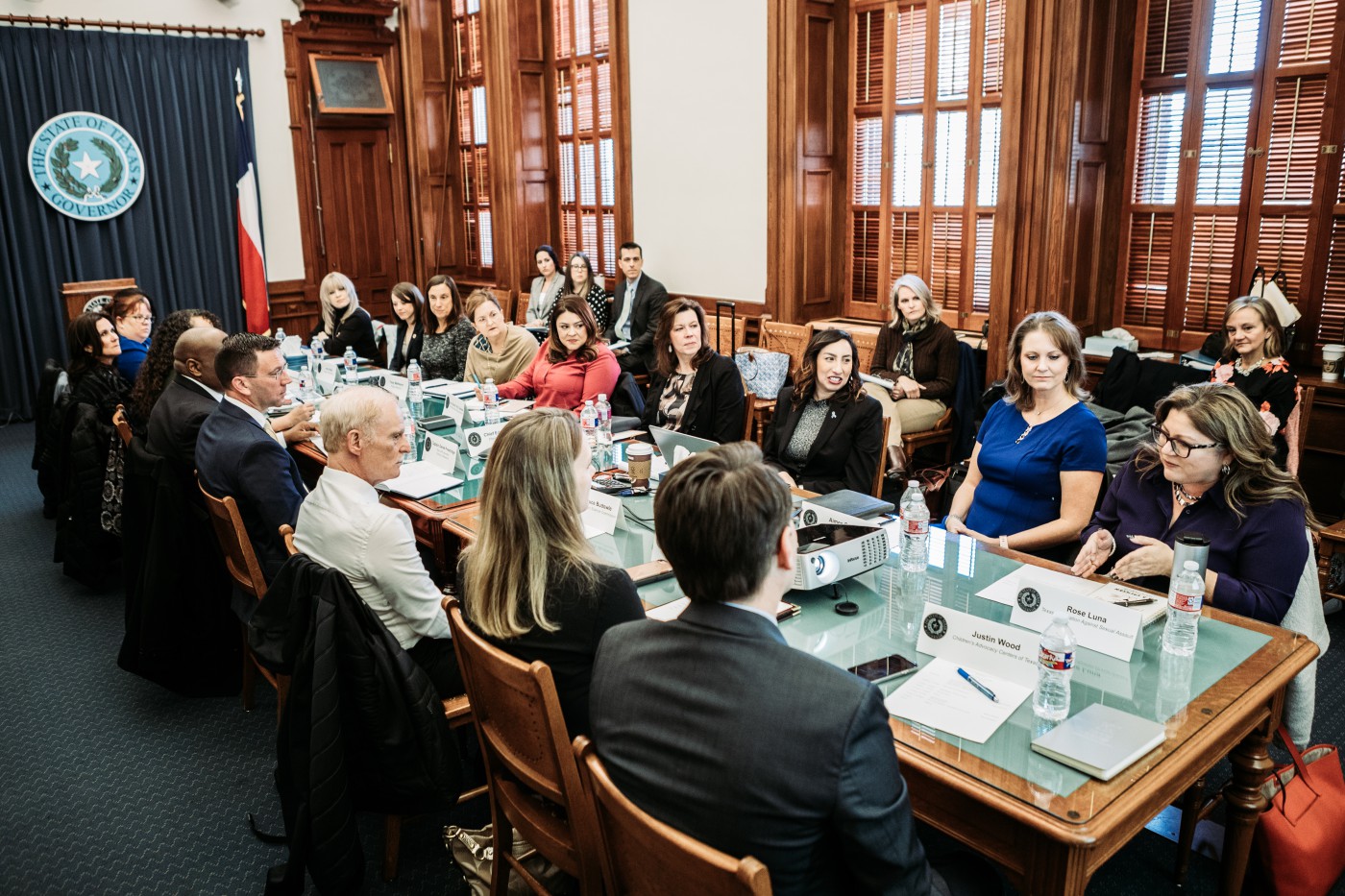
Sexual Assault Survivors’ Task Force Holds Inaugural Meeting In Austin


The
Office of the Governor's Sexual Assault Survivors' Task Force (SASTF)
today held its inaugural meeting at the Texas State Capitol. The meeting
included discussions on the structure and vision for the task force,
and served as a kick-off for phase one of the task force—which will
include the development of best practices for the collection,
preservation, tracking, analysis, and destruction of evidence in sexual
assault cases. 


“Texas continues to make great strides in the fight against sexual
violence, and the 86th Legislative Session was one of the most
significant in history for addressing the atrocity of sexual assault,”
said Governor Abbott. “The Sexual Assault Survivors’ Task Force is a
crucial component of our enduring goal to raise awareness, combat this
heinous crime, and secure justice for survivors. Together, we will
continue to develop methods of prevention, support these courageous
survivors, and ensure a brighter future for all Texans.”


Created by House Bill 1590 during the 86th Legislative Session and
authored by Representative Donna Howard and Senator Kirk Watson, the
SASTF is housed in the Office of the Governor's Public Safety Office and
seeks to establish a survivor-centered, trauma-informed, collaborative
and coordinated response to sexual violence experienced by adults and
children in Texas. The work of the SASTF is divided into five project
areas: forensic exams and evidence kits, policies and best practices for
the prevention, investigation and prosecution of sexual assault;
training and resources for law enforcement, prosecutors and judges;
improvements to the collection and reporting of data related to sexual
assault; and a statewide inventory of resources for survivors. The first
SASFT report, which will detail the work of the SASFT in its first
year, will be presented to Governor Abbott and the Texas State
Legislature on November 1, 2020. 


HB 1590 authorized the work of the task force for four years. The
task force will meet quarterly, with working group sessions in between.


The task force includes representatives from the following organizations and agencies:


Office of the Governor*


Texas Association Against Sexual Assault*


Children's Advocacy Center of Texas*


Office of the Attorney General


Texas Health and Human Services Commission


Texas Commission on Law Enforcement


Texas Forensic Science Commission


Texas Department of Public Safety (DPS) Crime Lab


Texas Association of Crime Laboratory Directors


Texas District and County Attorney's Association


Texas Society of Pathologists


International Association of Forensic Nurses Texas Chapter


Plano Police Department


North Richland Hills Police Department


Texas DPS Education, Training, and Research 


Texas A&M College of Nursing


Austin's SAFE Alliance


*Steering committee


Tuesday, January 28, 2020

School districts hold the responsibility of equipping students to participate in the democratic process... As we enter another election year...educators must promote unbiased information on our civic responsibilities with integrity and honesty.


AUSTIN – Attorney General Ken Paxton today mailed educational materials to Texas school districts detailing the importance of educators’ role in the civic process and providing guidelines for legally and effectively leading both employees and students through the 2020 election.   


“School districts hold the responsibility of equipping students to participate in the democratic process, but they, like all state agencies, must refrain from spending public funds to advocate for or against political candidates,” said Attorney General Paxton. “Pushing faculty or students to vote for or against a particular person is a direct violation of the Texas Election and Education Codes. As we enter another election year and many students register to vote for the first time, educators must promote unbiased information on our civic responsibilities with integrity and honesty.”   


The letters include a booklet of frequently asked questions and guidelines, available by clicking here.